This art museum by architect Renzo Piano straddles a canal in Oslo’s harbour .
A curving roof of fritted glass unites the three timber-clad buildings that comprise the complex, while two bridges cross the canal to link them at ground level.
The architects selected naturally weathered timber for the facades and interiors of each block, to reference the traditional Scandinavian construction of local buildings and boats.
Ten galleries are split between the three buildings, and one block also contains offices within four of its upper storeys.
Between the buildings, promenades stretch along both sides of the canal to lead to a sculpture park and sandy beach on the southern side of the water and a local ferry terminal on the northern side.
Other recent projects by Renzo Piano include The Shard, which opened earlier this summer, and the new wing at the Isabella Stewart Gardner Museum in Boston.
Here’s a project description from Renzo Piano Building Workshop:
The Tjuvholmen development commissioned by Selvaag Gruppen / Aspelin Ramm Gruppen in Oslo is located southwest of the centre of the city and is a continuation of the Aker Brygge development built in the 90’s. The site of the Tjuvholmen project is one of the most beautiful places in Oslo. The project will transform the formerly closed harbour into a public area connecting the Fjord and the centre of the city.
The RPBW project is on the western part of this development and consists of cultural programmatic elements as part of an agreement with the City of Oslo: the project includes 3 different buildings under a unique glass roof, one for Offices and Art exhibition and two exclusively for the Art Museum, the landscape design with bridges over the new canals and a small Sculpture Park.
The urban design creates a visual link between this cultural platform and the City centre of Oslo, developing the visual axis from Aker Brygge to the new complex. The integration of Art related activities in all three buildings and the mix with offices and leisure activities, makes the complex a vibrant part of the new urban fabric that will attract a very broad public.
The Design
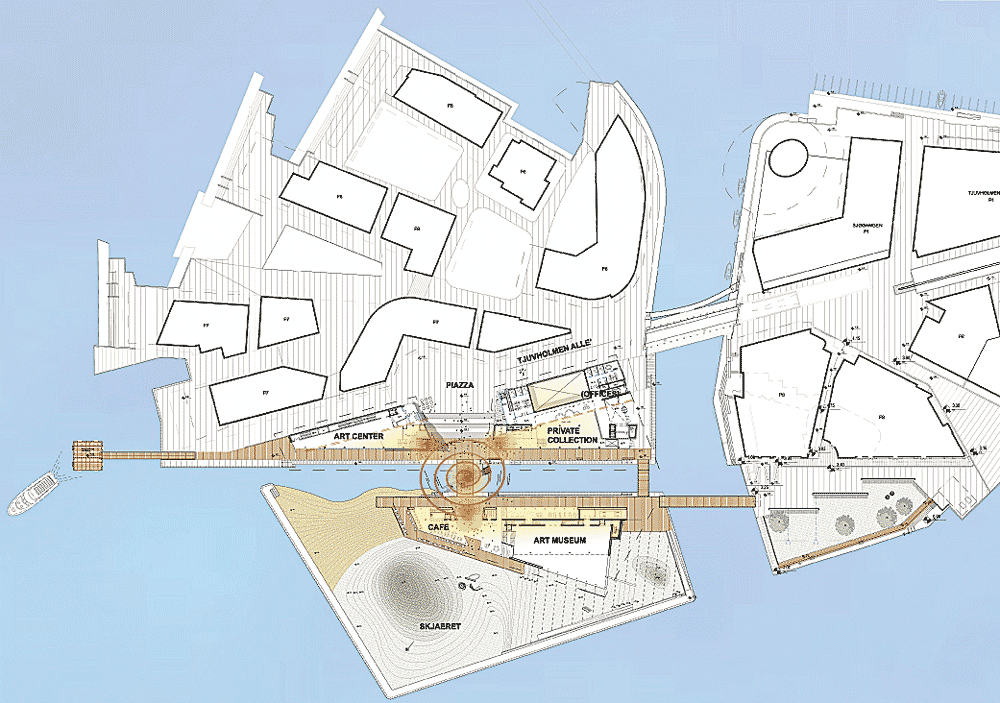
Overlooking the fjord, it seems inevitable to continue the sightline from the city along the Aker Brygge promenade to the far end of the new development. The entire promenade along the sea will be 800m long. Almost half of that length will consist of the new promenade of the project. The promenade will start at the bridge on the dock at Aker Brygge and continue along Strandhagen over to Skjaeret until it ends at a floating dock, from where a ferry may depart to other destinations along the inner Oslo Fjord.
The promenade along the canal will provide to the visitors the visual contact with the sea and nature, as an important experience of the journey.
On Skjaeret, the promenade is embraced by the building complex and the location of the art building along the canal, instead of along the sea as proposed by the city’s zoning plan, creates an active dialogue between the 3 buildings.
Between the art museum and the sea a softly undulating sculpture park fills the rest of Skjaeret and finishes in a sandy beach, protected by the wind and from the waves. It will be an open space for children and their parents to play and swim, to enjoy nature and the sea.
A café is planned alongside the beach with a facade that can be opened during good weather to enjoy views of the park and the wind gusts from the fjords as well as to extend the relatively small internal area of the café.
Across the canal over a wide bridge that links the two opposite banks, visitors will find the entrance to the other exhibition spaces at the quay level. A wide stair between them leads up to an urban Piazza where café’s, shops and entrances to other functions find their place.
Visitors will be able to continue along the quay of the canal to the tip of the new development which allows a spectacular view out over the Fjord, but also back to the centre of Oslo.
The Roof
The roof is a curved surface which covers all three buildings to emphasize their interaction as a cultural destination and the architecture of the complex.
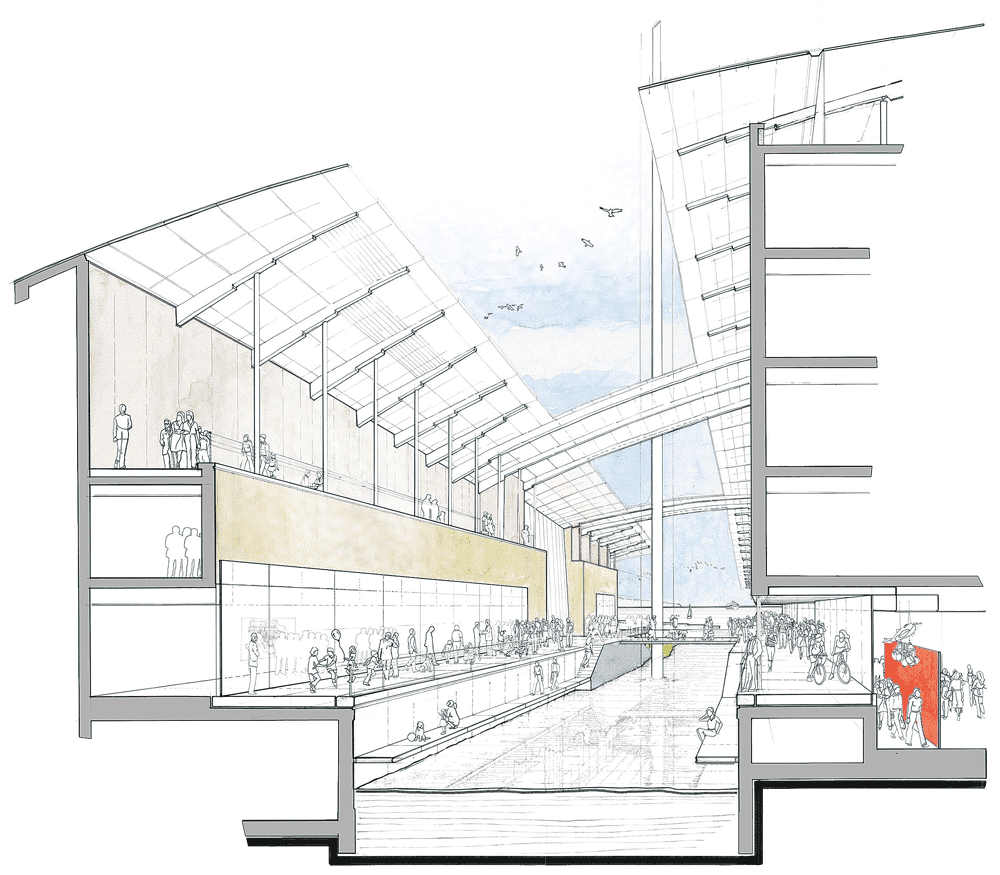
The design strongly identifies the project. Its curved shape, formed by laminated wood beams, crosses the canal between the buildings. The beams are supported by slender steel columns, reinforced with cable rigging, which refer to the maritime character of the site.
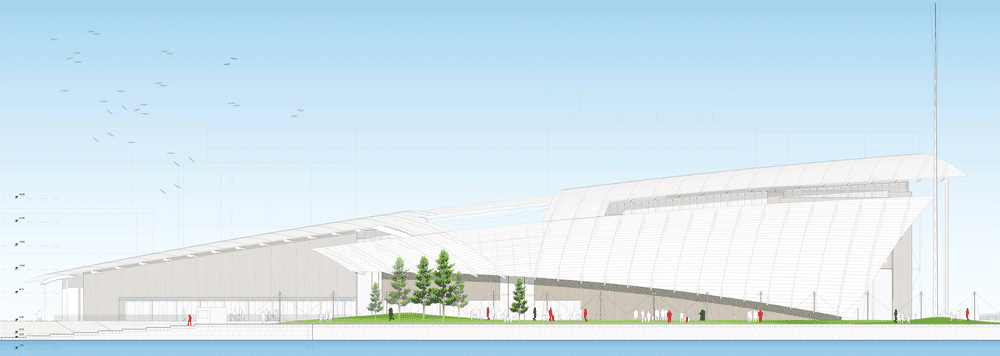
The roof geometrical shape is derived from a section of a toroid and it slopes down towards the sea. On Skjaeret, the roof almost touches ground in the Park, over a small water pond that prevents people to climb on the glass.
The roof surface is fully glazed and a ceramic fritting gives the glass the right solidness and the right transparency where needed. Some of the exhibition spaces, the museum lobby as well as the office atrium will receive daylight through the roof.
The edges of the roof extend generously outwards to reinforce the lightness of this glass plane and while obstructing daylight to a minimum, giving protection from rain and wind.
Exhibition Spaces
The project will have different kinds of exhibition spaces: visiting the museum will be a cultural journey going from one space to the other. This journey includes all three buildings on both sides of the canal and will bring the visitor through a series of 10 rooms, each with a different ceiling height, material and shape.
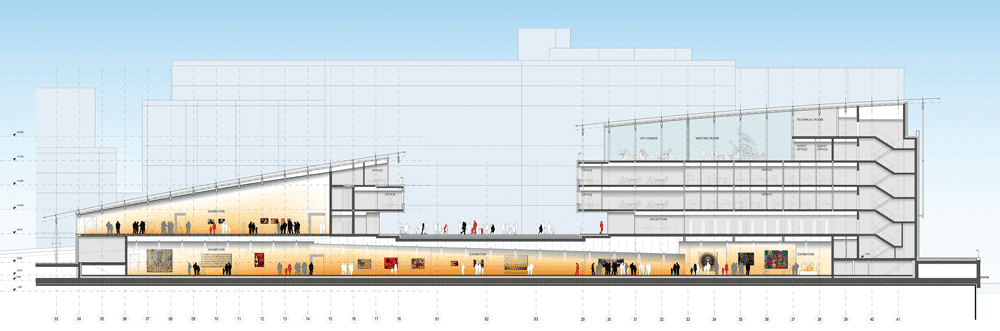
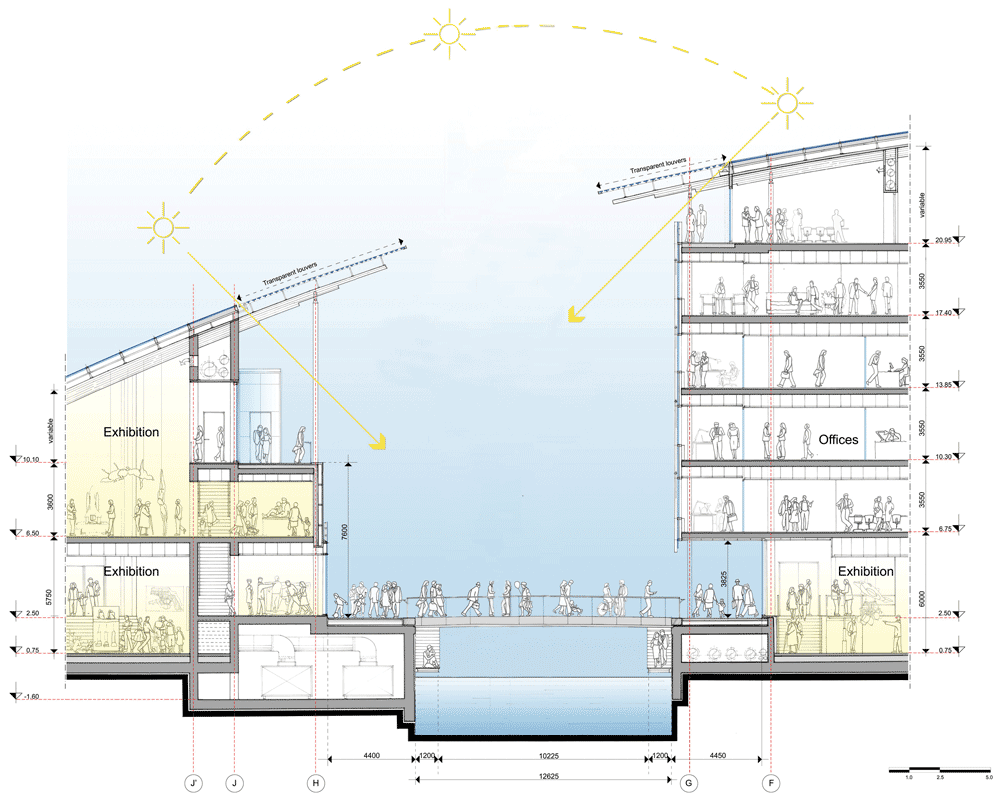
The exhibition spaces of the Art Museum on the north side of the canal will house the permanent contemporary art collection, which expands at ground level under the office building. This part is an open flexible space, extending under the Tjuvholmen Allee and the main stair between the quay level and the upper Piazza. In this area also educational activities of the museum will take place.
Site plan – click above for larger image
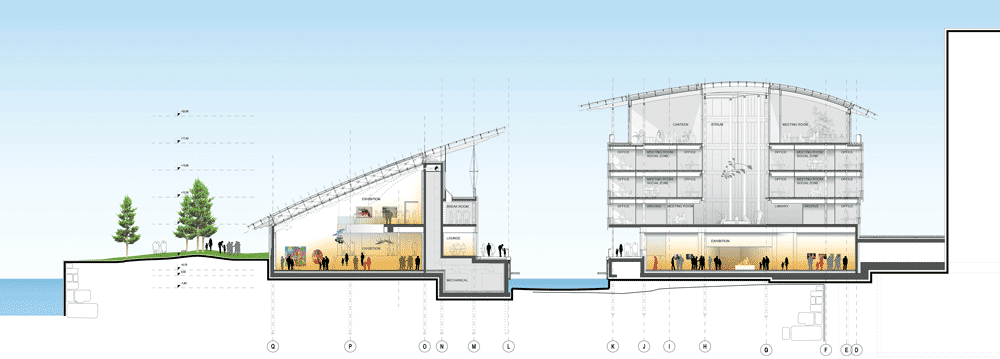
The building on Skjaeret, on the south side of the canal, will be for the temporary exhibition. The main exhibition space consists of two floors: one floor at ground level and one on the mezzanine, with natural light from a spectacular skylight in the roof. On the second floor a generous roof terrace will allow for the placement of sculptures outside. A small cafè is located next to the lobby and its terrace extends to Park and the beach.
Cross section – click above for larger image
Office Building
The office building along the Tjuvholmen Allee, has four floors and a mezzanine under the roof. A naturally lit atrium in the centre of the building connects the office floors. All floors will be rented to one tenant, which was very much involved the layout of the offices. The conference rooms as well as the common areas for the occupants are on the upper floors, taking best advance of the views and the terraces on these floors.
Long section – click above for larger image
Materials
The materials for the new buildings are few in order to emphasize the unity of the complex and are subdued to emphasize the roof as the most important architectural element.
The roof structure will be made of laminated wood beams, sometimes with steel elements, supported by steel columns. The glass of the roof has a dotted pattern, resulting in a light colour, a white ceramic frit that covers the whole surface reducing the transparency of the glass by 40%.
Elevation – click above for larger image
The facades have glazed areas on the ground floor where the public view is desired. The glazing is executed with low iron glass, as much as possible without coatings to enhance the transparency and to minimize the discoloration of the light into the exhibition spaces. The office glazing and less public facades may need coatings, with internal shades for glare control.
External sun shades on the facades, will make them more dynamic and will bring some color to the monochromatic wood facade.
Cross section detail – click above for larger image
The lobby to the temporary art space is completely glazed and allows the visual contact with the park and the sea, even from the Piazza on the Tjuvholmen Allee.
Naturally weathered timber was selected for the opaque parts of the façade (Aspen), which in a short time acquires a soft silver-grey color due to its exposure to the weather, The wood planks have a particular shape and the gaps between the planks increase where ventilation of the buildings is required.
Sectional perspective – click above for larger image
The use of wood as a material for structural elements, for the bridges, exterior paving and in the interiors, follows Scandinavian traditions. The use of wood is also a reference to the materials used for boats, while the slender steel elements in the bridges and the columns relate to the masts in the Oslo harbour, anchoring the building complex even more in its location.
via

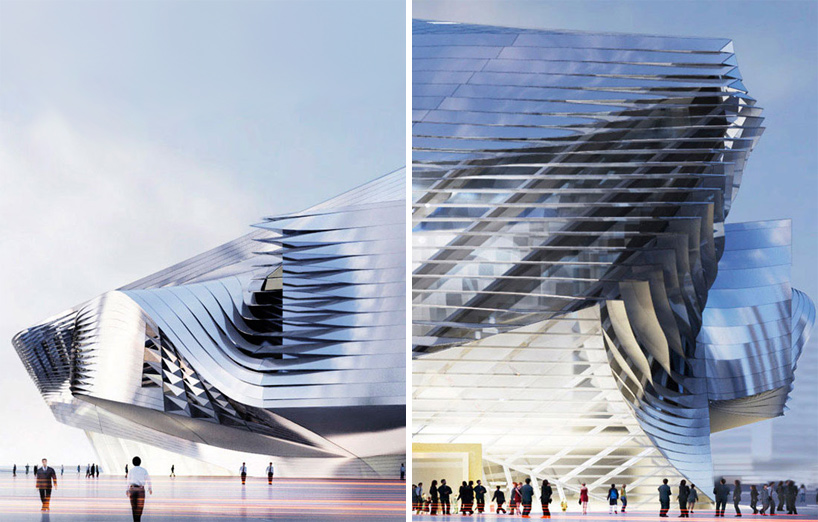
 © RTA-OfficeJinan is the intersection of Ji culture and Lu culture; it brings together the charm of Qi and Lu, and integrates the essence of Ocean and Mountains. It is the center of Qilu culture.
 © RTA-OfficeThe rich cultural resources provide Jinan with a solid culture industry base and a huge development potential.The city of Jinan has a strategic location supported with a good transportation hub (Yaoqiang International Airport, Beijing-Shanghai and Jinan-Qindao high-speed train lines, several important highways and an important transport artery that passes through the city).
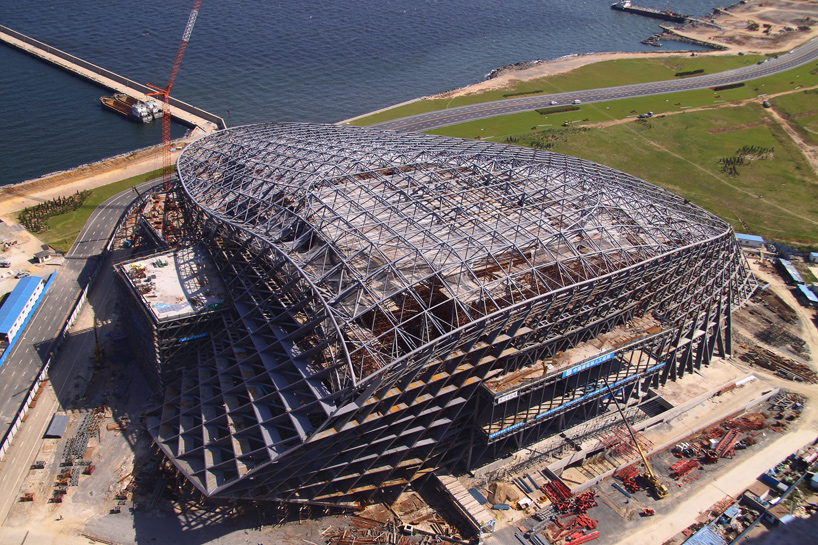
 © RTA-OfficeBy having this strategic location supported with good transportation hub, Jinan has lots of potential advantages and opportunities for development.The High-tech science and technology cultural center is located in the hi-tech zone in front of the international conference and exhibition center, near the cross between Industrial South Road and Northwest Exhibition Road.
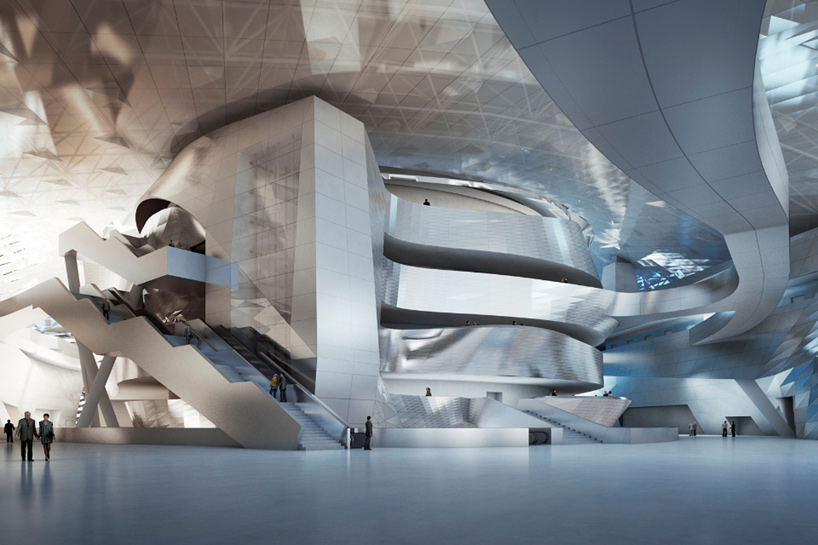
 © RTA-OfficeWe use the latest technology to create the shape of the 3D model; we believe that these buildings need to reflect the cultural flavor of Jinan in eastern and local specialties; this is a place of modern and Technology and the software language used is able to describe the soul of the location.So we made a unique exclusive design, showing all its modern character.
 © RTA-OfficeThe result is a strong contrast between the organic approach in the genesis of the soften edges of the new buildings and hardness of the surrounding buildings.The project is constituted by two buildings and a square.
 © RTA-OfficeBoth buildings are independent but connected. The two buildings, like dancing stones are placed in an urban stage that is the square. The organization of the parts is symmetric; the dancing stones are located in each side of an axis.
 © RTA-OfficeLike the city of Jinan, that has the east part and the west part linked by the center of the city which is the most cultural part of it.The square symbolizes the city; the two buildings represent the two sides: the east and the west, both parts linked by the square and in balance thanks to the “culture” which gives life to both of them and to the entire site.
 © RTA-OfficeThe square was renewed in order to emphasize its role as an urban stage and regenerator. All stairs were removed except the one in the north-center, where the stairs work as a stage box.
 © RTA-OfficeThe rest of the circulation of the square works by using ramps; ramps that allow a free movement without obstacles. The ramps generate topography that along with the green areas reminds the mountains were these stones were picked… The water is the river, the river that shaped the black stones.
 © RTA-OfficeIn the square the water is still and also comes out from inside the earth as a spring. The north part of the plaza has the function of exhibition space and the south one holds the two buildings.
 © RTA-Office.